Toddle · 2024–25
A mastery based grading system
Schools in the US and Australia grade students against standards, but Toddle could only grade with scores. I led the design of standards-based grading across assignments, reports and unit plans, from the first school interviews to the pilot. It became a key feature in opening up a market worth over $20M*.
Product designer & lead
2 designers, 20 engineers
Dec 2024 – Apr 2025
Web
4 minute read

$20M+*
market opened up in US public schools and the Australian curriculum
92%*
of the schools in our pilot moved to Toddle from another tool
70%*
less time spent writing rubrics once AI did the first draft

Standards import
Admins upload the PDF they already have. AI turns it into a list they can edit.

Rubric drafts
AI writes the first version of every level. Teachers fix what they don’t like.

Mastery gradebook
Every student’s progress on every skill, in one table.
Overview
What standards-based grading means
Most report cards give one number per subject. Standards-based grading breaks a subject into the skills a student is meant to learn that year, and grades each skill on its own.
A regular report card
Maths
78%
You can tell the student did fairly well. You can’t tell what they’re struggling with.
A standards-based report card
Adds fractions
Proficient
Solves word problems
Developing
Explains reasoning
Beginning
Fractions are fine. Word problems need work, and so does showing the steps.
Standard
A skill a student should learn by the end of the year, like “adds fractions”.
Mastery level
How far along they are with it. Schools name these differently. Beginning, Developing, Emerging and Proficient is one common grade scale.
Rubric
A description of what each level looks like, so two teachers grading the same work give it the same level.
The problem
Toddle graded with scores, not standards
Schools use Toddle to plan units, run assessments and send out report cards. Its grading was built on scores. Teachers could rate skills too, but only as an extra on top of the score. It was never the grade itself.
That’s a real problem for schools that grade by standards, which is the norm in some US public schools and under the Australian curriculum.
Admins
couldn’t link assessments to standards
Teachers
couldn’t track progress over time
Students and families
saw grades as arbitrary numbers
The brief
How might we connect every assignment to measurable standards, while keeping it simple for time-strapped educators?
Grading by standards takes a lot of setup: every standard has to go in, and every level of every skill needs a description. If that was slow, schools wouldn’t use it, however good the rest was.
What was missing, and what we built
Who
What was missing
What we built
Admins
Nowhere to keep standards
AI import and a standards table
Admins
No way to say what mastery means
Grade scales with a mastery level
Admins
No way to turn grades into one level
8 calculation methods to choose from
Teachers
Rubrics slow to write, and not tied to standards
Standards-based rubrics, drafted by AI
Teachers
A gradebook that only showed scores
A mastery gradebook and insights
Students and families
Grades that didn’t explain anything
A gradebook per student, by standard
My role
What I worked on
I was the designer and product lead. I worked with one other designer and about 20 engineers from December 2024 to April 2025, while the rest of Toddle was in the middle of its 2.0 upgrade.
I talked to pilot schools, went through the feature requests our sales and success teams had collected, studied competitors, mapped who does what, planned the build with engineering, and designed the screens.
Research
What schools told us
I went through months of feature requests and spoke to teachers and admins at our pilot schools. Three things came up again and again.
Writing rubrics takes too long
“Right now I have to manually copy and paste each goal into the rubric. It would be great if I could auto-generate the rubric from the learning goals I’ve already tagged, and then edit it if needed.”
Grade 3 teacher
Teachers still want scores, too
“I spend hours grading quizzes but all my students see is a B minus. They don’t know why they got it or how to improve. I do want to give them a score, but I also want to show them where they can grow.”
Grade 8 teacher
Admins want to set the rules
“I want to set up clear guidelines, like calculation methods, standards and rubric structures, for my teachers. I’d still like them to have some say where it makes sense.”
School admin
Competitor analysis
What other platforms do
I looked at five platforms that already offer standards-based grading. I went through their help docs, signed up for free accounts where I could, and used an LLM to double-check what I found.
Platform
Where standards live
How they calculate mastery
Platform 1
Outcomes → Alignment
Weighted average, decaying average, N number of times, most recent, highest, average
Platform 2
Resources → Objectives
Average, highest, decaying average (75% by default)
Platform 3
Setup → Standards
Average, summative only, or both
Platform 4
Admin → Standards
Most recent, power law, weighted average, maximum, decaying average, teacher judgement, custom formula
Platform 5
Setup → Standards
Mean, median, mode, highest, specific weighting, specific sum
Every platform calculated mastery in more than one way, and no two lists matched. That told us one calculation method would never be enough. Schools would need to pick their own, and we made a set for admins to choose from.
Personas
Three groups touch every standard
Admins set things up centrally, teachers build their courses and assignments around standards, and students and families need to see progress clearly.
Admin
Age 35–45
Runs curriculum setup and school-wide systems. Decides which standards are used and how grades are calculated, but wants teachers to have room to adapt.
Teacher
Age 28–45
Plans courses, picks standards from the admin’s list and builds units and assessments around them. Then teaches, grades and talks to families every day, so the tools have to stay simple.
Student & family
Age 6–17
Want to know what’s being learned, how it’s going, and what to work on next.
How a standard moves between them

Admin
imports standards and views insights
→

Teacher
maps standards to courses and assesses students
→

Student & family
see mastery
The solution
Standard based grading built into the flow schools already used for scores
Toddle already had a full grading flow built on scores, and I didn’t want standards to end up as a second product sitting next to it. So we went through every step of that flow for each role, and worked out what to adapt, what to rebuild and what to add. What came out fits into the way schools already used Toddle, and it comes down to these steps.
Step 1 · Add standards
Standards came in every format except a useful one
The problem
Toddle had nowhere to keep a school’s standards. Schools had them in PDFs and spreadsheets, and getting them in meant typing them all out.
What we did
Admins upload the file they already have, and AI pulls each standard into a table that works like a spreadsheet. They can also build a set from scratch or import an official one. We reused the same table on every setup screen, so admins only learn it once.
Step 2 · Set the rules
Every school defines mastery differently
The problem
Toddle’s grade scales were built for scores, and it could work out a GPA but not a level. Schools needed to say what each level means and how several grades become one, and they all do this differently. The five platforms I studied had five different lists of methods.
What we did
Admins set up a grade scale once, with a cutoff and a value for each level, and choose which level counts as mastery. Every rubric built from that standard set picks it up.

Then admins choose how grades add up, in two places. Horizontal is one standard graded several times over a term. Vertical is several sub-standards rolling up into a parent, like “Reading”. We built several calculation methods like mean, weighted mean, decaying average, most recent, mode, maximum value, power law and best fit for admins to choose from and met parity with competitors.

Worked example · decaying average, using the scale above
Task 1 · value 80
Proficient
Result so far: 80
Task 2 · value 60
Developing
Result so far: 67
Task 3 · value 100
Distinguished
Result so far: 88.45
Task 4 · value 80
Proficient
Result so far: 82.96
Each newer grade counts for 65%. 82.96 is above the 80% cutoff, so the final level is
Distinguished
Step 3 · Grade
Rubrics were slow to write and weren’t tied to standards
The problem
A rubric describes what each level looks like, so two teachers give the same work the same level. Toddle’s rubrics weren’t connected to standards, and someone had to write every description by hand.
What we did
A teacher picks the standards, and Toddle AI drafts a description for every level. They edit what they don’t like. Admins can save rubrics as templates, and when students hand in work, the grades go straight into the gradebook.
Example rubric · Finds the main idea
Beginning
Names what the text is about
Developing
States the main idea, with some help
Emerging
States the main idea on their own
Proficient
States the main idea and points to evidence for it
70%* less time on rubrics, in internal testing
Step 4 · Track progress
An average hides the skill a student is stuck on
The problem
The gradebook showed scores. A student who is Proficient in four skills and Beginning in one looks fine on average, and a B minus doesn’t tell them what to work on.
What we did
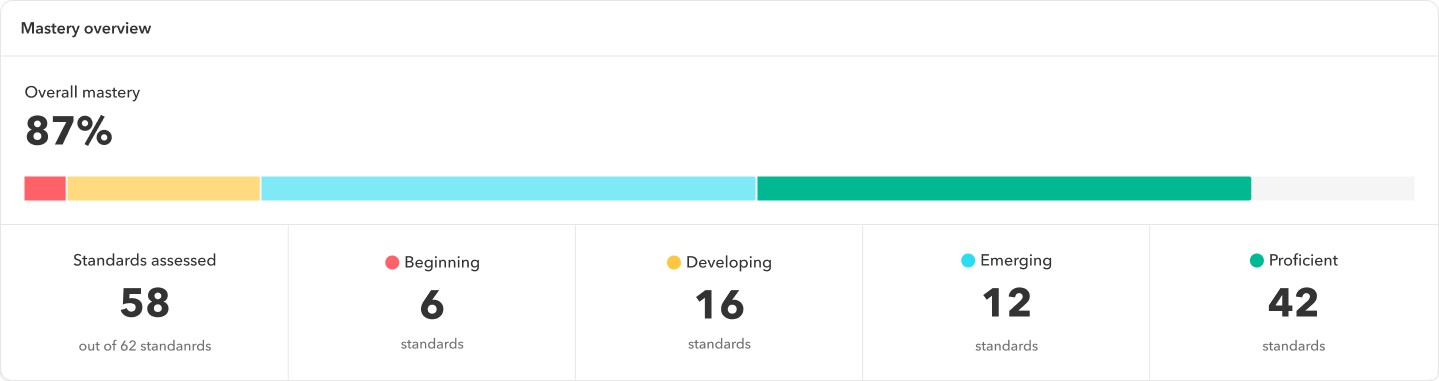
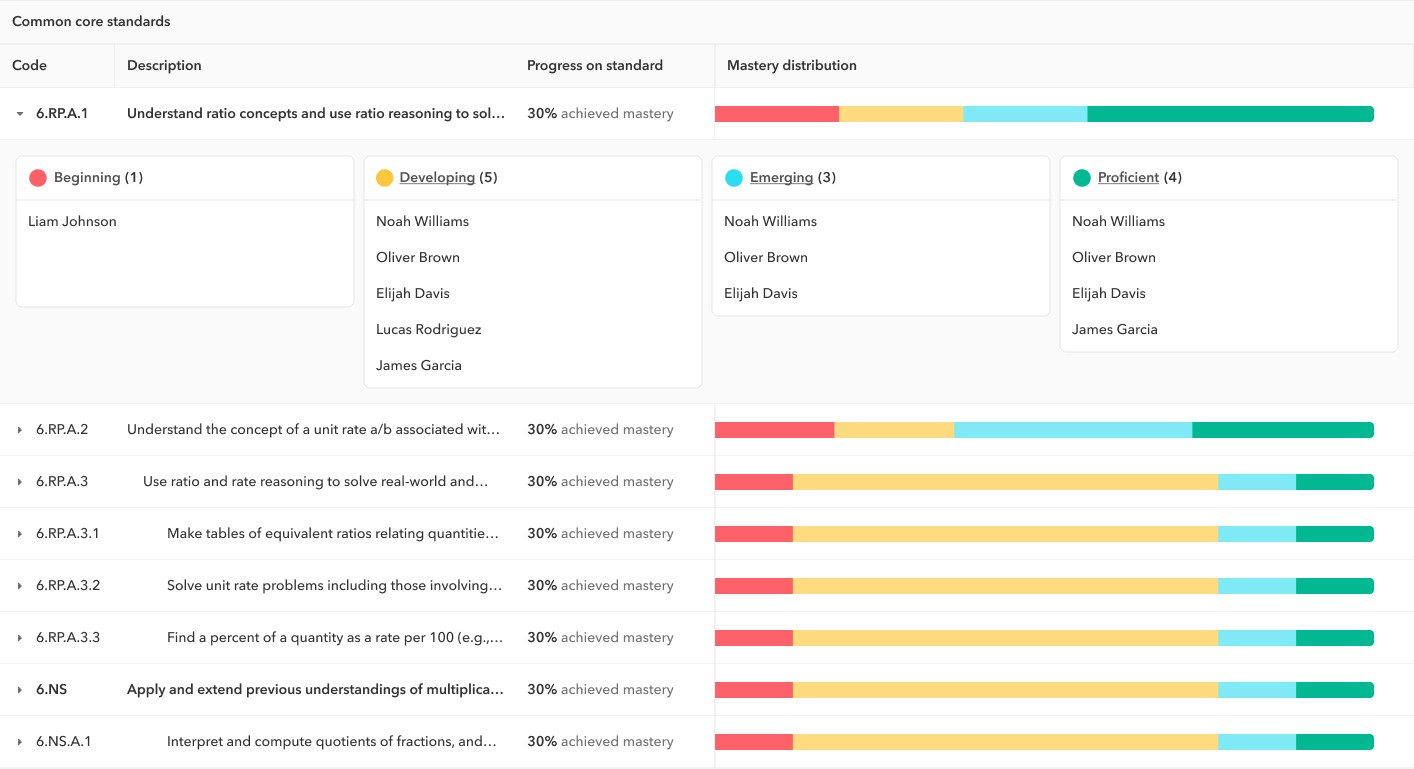
The mastery gradebook has a row for each standard and a column for each student. It sits next to the assessment gradebook, so schools using both can switch. Teachers can open a student’s history, change a final level if they disagree, and share a student’s gradebook with them and their family.


Each student has a bar showing how close they are to each level, and a graph of every assessment over time.
Teacher’s view - students vs standards
Student’s view - standard vs assignment

With the assistance of another designer who led the insights team, we built insights by student, standard and course, so teachers can decide what to reteach.

Impact
What happened
Schools started signing up within a few weeks of our first demos. It was a big part of how Toddle got into US public schools and the Australian curriculum, a market worth over $20M*.
$20M+*
market opened up in US public schools and the Australian curriculum
92%*
of the schools in our pilot moved to Toddle from another tool
70%*
less time spent on rubrics, measured in internal testing
35–50%*
of teachers’ time we estimate they could save by using one tool instead of several
We built it in phases, because Toddle 2.0 was changing courses, navigation and permissions at the same time. We piloted with five schools and shipped fixes every two weeks. Next on the list were weighting standards and personal mastery paths, shaped by what those schools told us.
Looking back
What I’d do differently
Let a standard have its own grade scale.
Our competitor research showed that other platforms let schools put a grade scale on a single standard, not just on a whole set. We tied scales to sets because it was simpler to build for a first version. After release, many schools turned out to use one standard set across early years and senior years, with a different scale for each. They didn’t want to split it into separate sets, because that would split their insights too.
Leave room for more than one set per subject.
Some schools give each subject one standard set, but also grade other skills that count towards the final grade. We had nowhere to put those. It’s planned for a later version for now, but we could have put more thought into it.
Let a standard work across subjects.
A standard set could only belong to one subject or course. So if a maths teacher and an English teacher taught the same standards, the school couldn’t see how a student was doing on them in one place. It needed a separate set for each subject. Schools that grade fully by standards do this a lot, and we only found out on school visits after release. We hadn’t scoped it, and we’re solving it now.
Get everyone in a room on day one.
New people kept joining, and I kept explaining the project from scratch. A kickoff with every team would have fixed that.
Shout-outs
What people said
🎉 Big shoutout to @Sulakshana for making huge strides in product design! 🚀 Over the past few months, she has not only refined her design process but has also taken on multiple projects with ease, moving from a focused approach to handling a broader horizontal scope across teams. It’s been amazing to see how she has scaled up, juggling multiple initiatives while ensuring quality and impact remain top-notch. Your ability to adapt, grow, and drive impact has been truly inspiring. Keep up the fantastic work! 💪👏
“I love the bar on the right and the placement of the students within that. I just want to say, thank you. That is exactly what we were looking for.”
“I can’t even tell you how long we’ve been looking for something like this, and this is just remarkable to see.”
“All of our teachers have worked on these rubrics by hand. One of the things we love about your platform is having AI help to craft them. I think that’s really helpful.”
“Loving this new grading setup view and the grading configurations… wow! Yay for standards-based rubrics. Pretty impressive.”
“Kudos to Sulakshana for blowing a school away with the standards-based designs they made just for that school, to show how we’d meet their needs. The deal had been in conversation for almost two years, and it closed right after the meeting.”
* Numbers marked with an asterisk are indicative. They show the direction and rough size of the change, but the real figures may vary.
A mastery based grading system
Toddle · Product designer & lead · 2024–25
Took Toddle from grading by score to grading skill by skill, from the first school interviews to the pilot.
Enter password to read